
Impact Report 2025: When Diving Becomes Conservation
There is a moment in the Galápagos that changes people.
It usually happens underwater.
The current is strong. You hold onto volcanic rock at Darwin’s Arch. The water is deep blue — almost endless. Hammerheads pass in silver formations. And then, slowly, the ocean shifts.
A shadow emerges from below.
Massive. Calm. Ancient.
An adult female whale shark.
For most divers, it is the encounter of a lifetime.
For us, it is also a responsibility.
Because every time one of these giants appears, there is still so much we do not know. Where has she come from? Is she pregnant? Where will she travel next? How deep does she dive? Why do they gather here — and nowhere else like it?
In 2025, together with our divers, we turned that curiosity into measurable action.
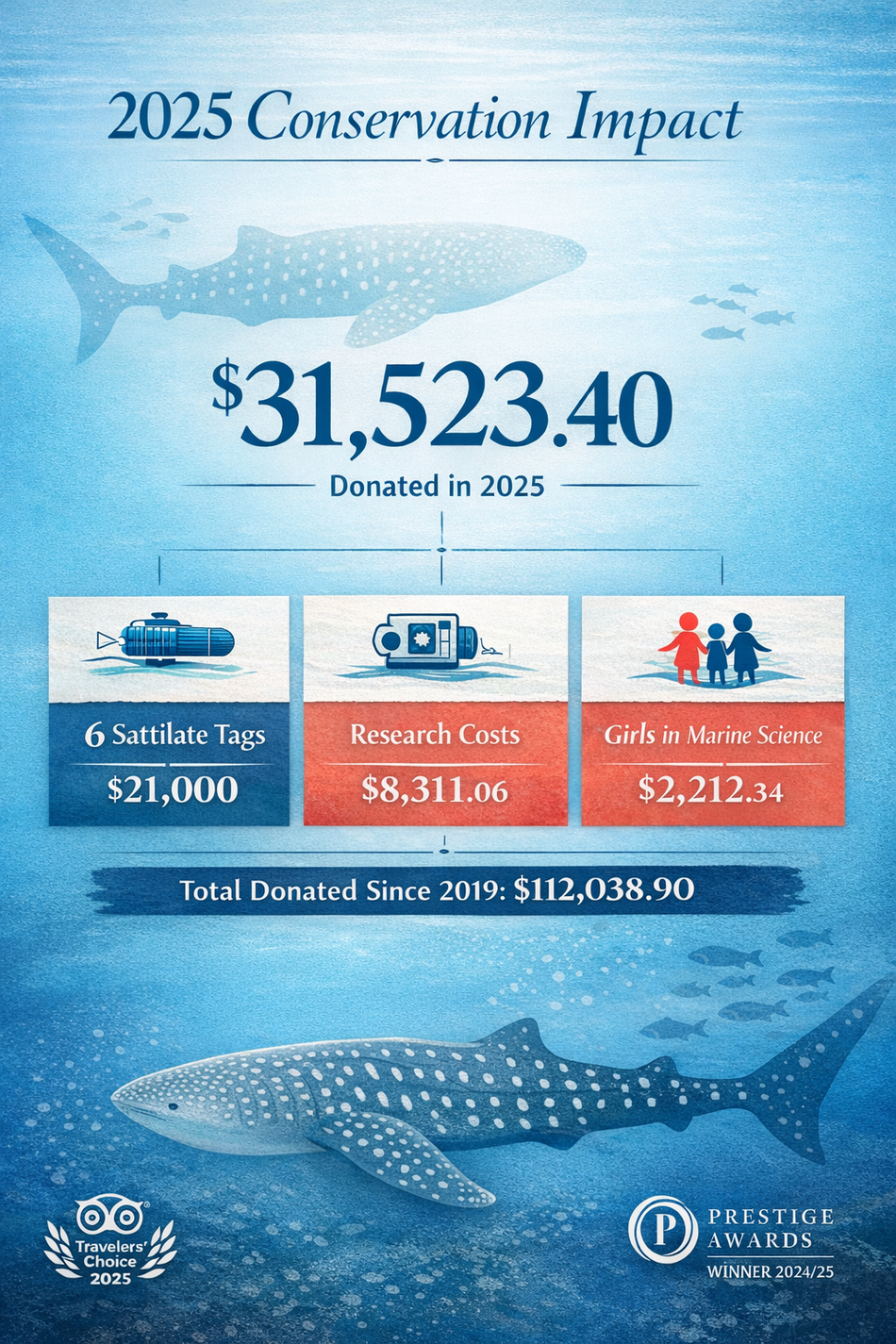
This year alone, Galapagos Shark Diving donated USD 31,523.40 to marine conservation initiatives in the Galápagos Islands.
USD 29,311.06 was directed to the Galápagos Whale Shark Project.
USD 2,212.34 supported Chicas con Agallas — Gill’s Club.
Since 2019, our total contributions now exceed USD 112,000.
That number represents something much bigger than funding.
It represents divers choosing to travel differently.
What That Funding Actually Does

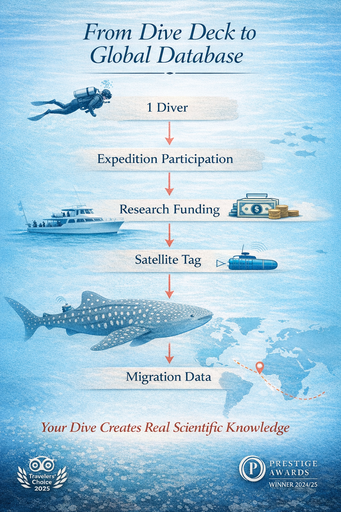
A satellite tag is not just a device.
It is a question placed on the back of a whale shark.
Each tag costs approximately:
USD 3,500 for the unit
USD 500 for satellite transmission time
And additional logistical costs to support research operations at sea
In 2025, the funding generated through our expeditions allows the Galápagos Whale Shark Project to purchase and deploy six satellite tags during the upcoming research season.
Six tags.
Six female whale sharks.
Six migration stories that will begin transmitting data back to scientists once deployed.
These tags will record depth, temperature, and movement patterns — revealing how these giants move across the Pacific Ocean.
Some may travel thousands of kilometers.
Some may dive deeper than we expect.
Some may help answer whether Darwin’s Arch is a migratory corridor, a feeding site, or something far more complex.
The tags funded this year will be placed by researchers during dedicated field expeditions. The data they transmit will become part of long-term global whale shark science.
This is not symbolic conservation.
It is active research.
Why This Research Matters
Marine science in Ecuador receives very limited governmental funding. Long-term research initiatives depend heavily on private donors, international foundations, and conservation-driven tourism partnerships.
The Galápagos Whale Shark Project conducts some of the only dedicated research on adult female whale sharks in the world — the very individuals that visit Darwin and Wolf.
Their work includes:
- Satellite tagging
- Photo-identification cataloging
- Ultrasound examinations to assess potential pregnancies
- Blood sampling and physiological research
- Long-term data analysis
In 2025, the project also acquired a new ultrasound unit — a major advancement in understanding whether the large females aggregating in the Galápagos may be pregnant.
The answers to these questions do not stay local.
They influence international conservation policy.
They inform marine protected area management.
They contribute to global species protection frameworks.
And this year 2026, six more whale sharks will carry that research forward because divers chose to participate.
A Growing Commitment Since 2019
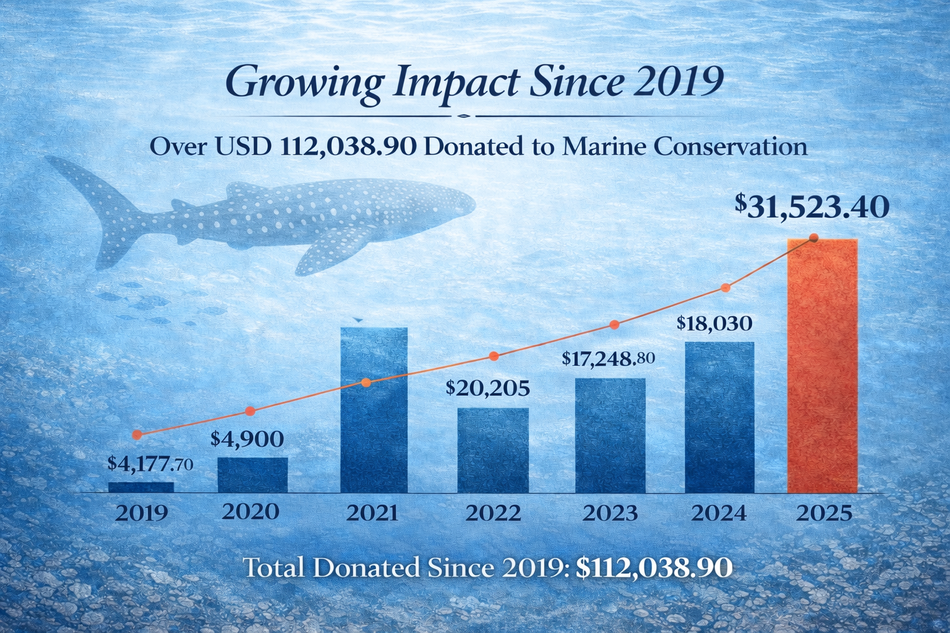
When we began supporting conservation in 2019, our contribution was modest.
$4,177.70.
But every year, more divers joined. More expeditions sold. More awareness grew.
And with that, the impact expanded:
2020 – $4,900
2021 – $20,205
2022 – $15,954
2023 – $17,248.80
2024 – $18,030
2025 – $31,523.40
Since 2019, the total contributions exceed USD 112,000.
This is not a marketing story.
It is a trajectory of responsibility.
Diving With Purpose
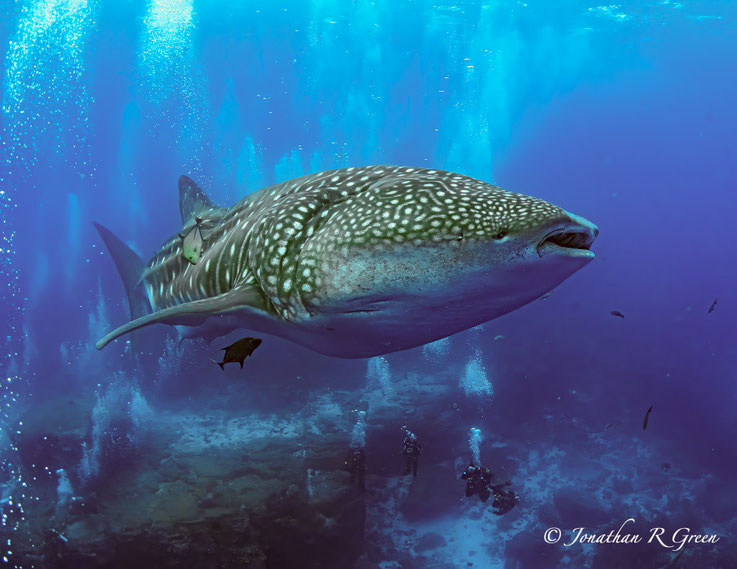
Every Citizen Science Expedition includes an active shark scientist from the Galápagos Whale Shark Project onboard.
Guests learn directly about current research. They assist with whale shark photo identification. They participate in Shark Count protocols. They engage with the real data being collected.
You do not simply witness science.
You help enable it.
And when those six tags are deployed this season, their signals will represent something powerful:
Divers who chose to leave more than bubbles behind.
“Diving in the Galápagos should not only change you — it should protect what you came to see.”
Jenny Green, Founder Galapagos Shark Diving




Write a comment