
The Galápagos Whale Shark Project

Science That Protects Giants
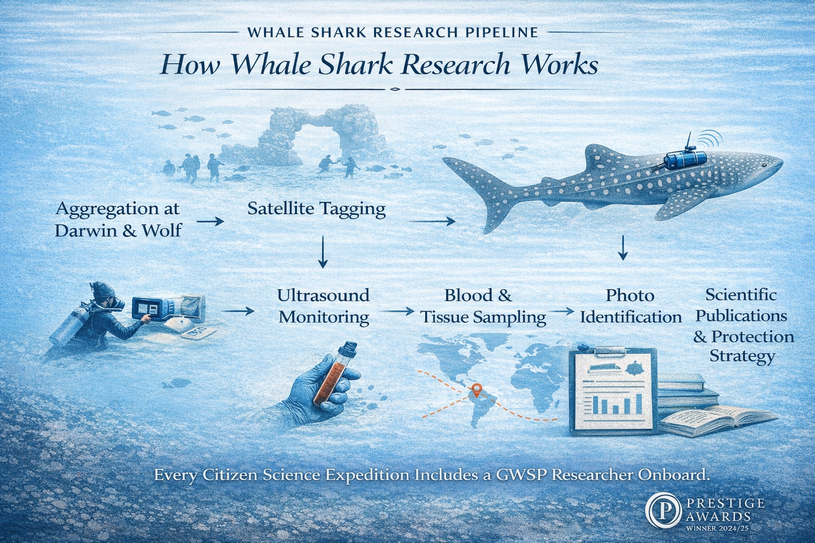
In 2025, Galapagos Shark Diving donated USD 29,311.06 directly to the Galápagos Whale Shark Project.
This funding is part of a larger commitment that now exceeds USD 112,000 donated since 2019.
But what does that actually mean?
It means satellite tags being purchased.
It means fuel for research expeditions.
It means ultrasound equipment to assess potential pregnancies.
It means blood equipment to check health data and baseline information.
It means data analysis that can shape conservation policy.
Find our Full Impact Report 2025.
Why the Galápagos Matters
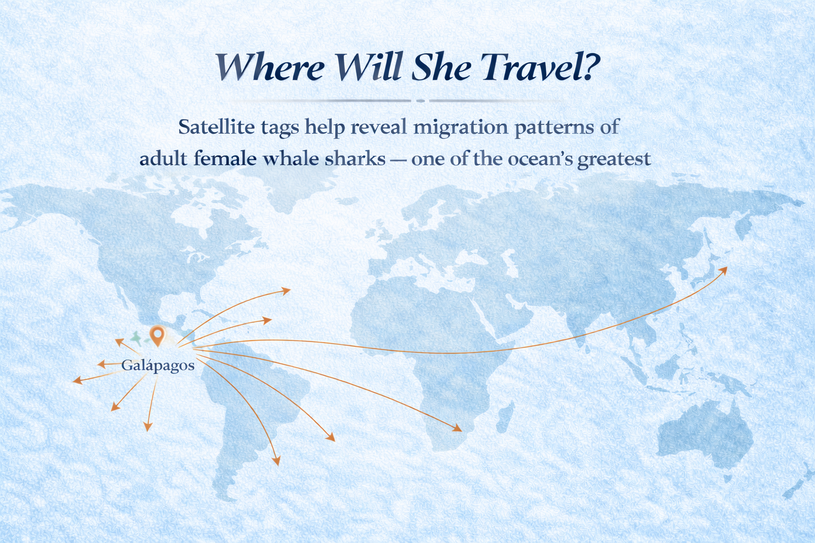
The Galápagos Islands are one of the only places in the world where large adult female whale sharks aggregate seasonally.
Not juveniles.
Not mixed populations.
But enormous, mature females — often over 12 meters long.
Why they come here remains one of the great mysteries of marine biology.
Are they pregnant?
Are they feeding?
Is Darwin’s Arch part of a larger migratory corridor?
The Galápagos Whale Shark Project is one of the only organizations dedicated to answering these questions.
What Your Funding Supports
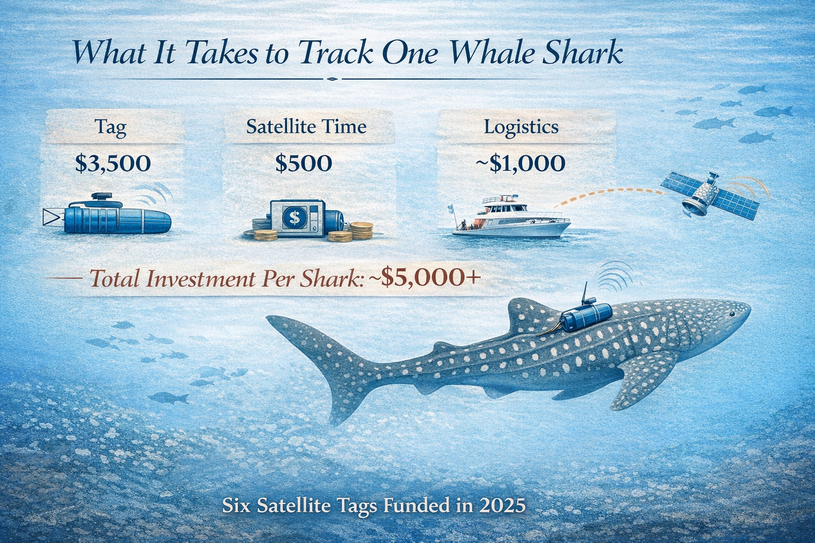
Through the 2025 donation, six satellite tags will be deployed during the upcoming research season.
Each tag costs approximately:
USD 3,500 for the unit
USD 500 for satellite time
Plus logistical and field expedition costs
These tags record:
- Depth profiles
- Ocean temperature
- Long-distance movement patterns
The project also conducts:
- Photo-identification cataloging
- Blood sampling
- Ultrasound research
- Long-term movement tracking
- Data analysis
In 2025, the project acquired a new ultrasound unit — significantly improving their ability to investigate whether adult females in the Galápagos are pregnant.
This is groundbreaking.
Very few places in the world have access to adult female whale sharks for research.
A Growing Commitment
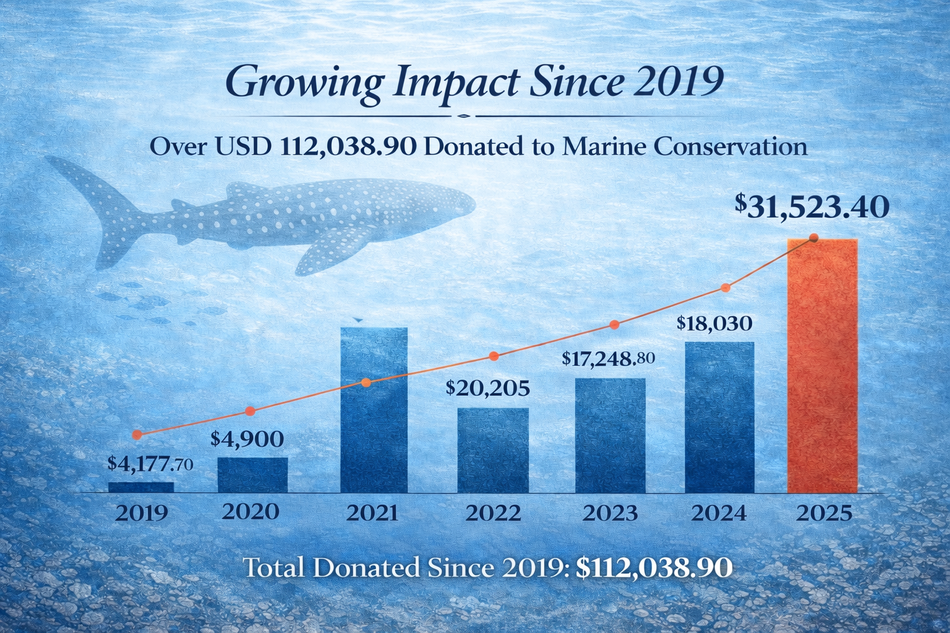
When we began supporting conservation in 2019, our contribution was modest.
$4,177.70.
But every year, more divers joined. More expeditions sold. More awareness grew.
And with that, the impact expanded:
2020 – $4,900
2021 – $20,205
2022 – $15,954
2023 – $17,248.80
2024 – $18,030
2025 – $31,523.40
Since 2019, the total contributions exceed USD 112,000.
This is not a marketing story.
It is a trajectory of responsibility.
Research Depends on Private Support

Marine science in Ecuador receives limited governmental funding.
Long-term research depends heavily on private donors, conservation foundations, and purpose-driven tourism partnerships.
That is why structured, transparent funding matters.
And that is why every Citizen Science Expedition includes one active GWSP shark scientist onboard.
Guests are not removed from the science.
They are immersed in it.
They hear firsthand about current tagging results.
They learn about data gaps.
They understand why funding continuity is critical.
This partnership is not symbolic.
It is operational.
“Join a Citizen Science Expedition and directly support active whale shark research.”
Jenny Green, Founder Galapagos Shark Diving




Write a comment