
NAME A WHALE SHARK 2025
When a Name Becomes Part of Marine Science
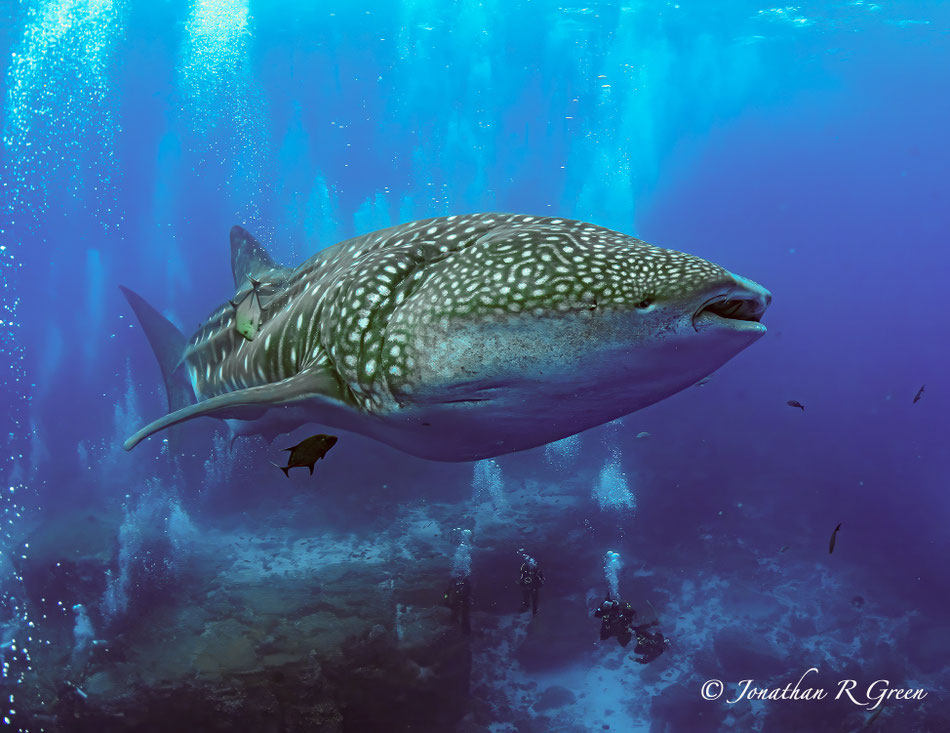
There is something deeply human about naming.
We name what we love.
We name what matters.
We name what we want to protect.
In 2025, Galapagos Shark Diving donated USD 31,523.40 to marine conservation in the Galápagos Islands. Of that:
USD 29,311.06 directly supports the Galápagos Whale Shark Project.
USD 2,212.34 supports Chicas con Agallas (Gill’s Club).
That funding made it possible to purchase six satellite tags, including satellite transmission time — which will be deployed during the upcoming research season on adult female whale sharks.
And this is where the story becomes personal.
For more information check our “Impact Report 2025”.
The Name a Whale Shark 2025 Contest
Every diver who joined one of our Citizen Science Dive Expeditions in 2025 was invited to submit one name.
Not as a gimmick.
Not as a symbolic gesture.
But as a thank-you for actively funding and participating in shark research.
At the end of the year, we placed all submitted names into a draw. The number of names drawn corresponds directly to the number of satellite tags funded.
This year: six.
The selected names are:
- Chri
- Isabella
- Paula
- Tayla
- Sakura
- Olivia
Once the tags are deployed by researchers, each whale shark will be officially registered in Sharkbook.ai, the international whale shark database used by scientists around the world.
These names will enter global marine science records.
They will appear in migration data sets.
They will be linked to depth profiles and ocean temperature records.
They may one day appear in peer-reviewed publications.
That is what makes this different.
This is not naming an animal for novelty.
This is becoming part of its scientific story.
Why Only Citizen Science Divers?

All guests traveling with Galapagos Shark Diving support research through their trip.
But only participants of our Citizen Science Expeditions are eligible to submit names.
Why?
Because these divers are not only funding research — they are directly participating in it.
Every Citizen Science Expedition includes an active shark scientist from the Galápagos Whale Shark Project onboard.
Guests assist with:
- Whale shark photo-identification
- Shark Count surveys
- Scientific briefings and discussions
- Conservation data protocols
They understand the science behind the tag.
They understand the significance of the migration data.
They understand why adult female whale sharks in the Galápagos are one of the most important unanswered questions in shark research.
And so when they submit a name, it carries weight.
A Name That Travels Thousands of Kilometers

When the tags funded in 2025 are deployed, they will begin transmitting movement data via satellite.
Some whale sharks may travel across the Pacific.
Some may dive deeper than 2,000 meters.
Some may reveal migration corridors we never documented before.
And somewhere in that data stream will be:
Chri.
Isabella.
Paula.
Tayla.
Sakura.
Olivia.
Six names.
Six research subjects.
Six stories still unfolding.
"2027 expeditions are already filling — secure your place in future impact."
Jenny Green, Founder Galapagos Shark Diving




Write a comment